
What are The Different Data Center Tiers and Why They Matter?
AMAX Technical Blog
March 14, 2022
Datacenter tiers are a crucial part when selecting a facility to host data. The tier of the data center you utilize dictates the level of security and how much downtime you could experience per year. Datacenter tiers are an established ranking system that stipulates the reliability of the data center infrastructure. 4 tier types have different rankings. Tier 1 is the lowest rated tier and is the most straightforward tier compared to tier 4 is more complex and the best performing level.
The Uptime Institute Tier Certification System, an international standard for data center performance, has many criteria for each data tier operation. Different factors are considered, including service availability, uptime guarantees, redundancy levels, cooling and power infrastructure, service costs, data center security levels, and much more. The majority of data center facilities request an evaluation from the Uptime Institute to determine the official rating. Staff must provide site plans and blueprints for the Uptime Institute to provide the most suitable rating.
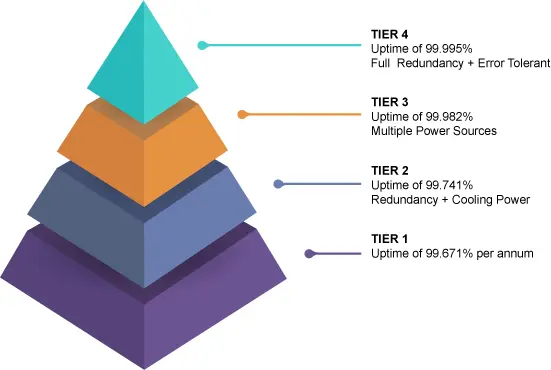
Below are the four certified data center tiers:
- Tier 1: A data center with a single path for power and cooling and no backup components. This tier has an expected uptime of 99.671% per annum. Tier 1 provides the power and cooling capacity to support a full IT workload. Staff must shut down operations regularly for maintenance and repair. Tier 1 clients can expect up to 28.8 hours of downtime annually. This tier is suitable for small businesses and start-ups, and it is the most affordable option.
- Tier 2: A data center with a single path for power and cooling and some redundant and backup components. This tier offers an expected uptime of 99.741% per annum. Tier 2 has the same components as Tier 1 but allows additional backup options to provide more protection against disruptions. It relies on a single distribution path for power and cooling, so clients can expect up to 22 hours of downtime per year. This tier is ideal for SMBs looking for a cost-effective and reliable option that offers backup.
- Tier 3: A data center with multiple paths for power and cooling and redundant systems that allow staff to work on the setup without taking it offline. This tier has an expected uptime of 99.982% per annum. Tier 3 does not require a total shutdown during maintenance and repair, unlike Tiers 1 and 2. It has all the features of Tier 2, but facilities must also have N+1 availability (N is the necessary capacity to support the IT load, and +1 refers to the extra backup components). Tier 3 clients can expect up to 1.6 hours of downtime per annum. Tier 3 is suitable for large companies with larger IT workloads that need extra safeguards.
- Tier 4: A completely fault-tolerant data center with redundancy for every component. This tier comes with an expected uptime of 99.995% per annum. Tier 4 data centers add fault-tolerance mechanisms to the Tier 3 requirements. Data centers must ensure they have two generators and that each distribution path is independent. If a component fails, it must not cause a redundant domino effect. They must also ensure operations continue for a maximum of 96 hours after a power outage and that the power source is not connected to an external source. Tier 4 clients do not experience more than 26.3 minutes of downtime per year. This tier is suitable for large enterprises and government organizations with intensive customer or business demands.
Each of these tiers is progressive and is suitable for different business requirements. Data centers can move up and down the ranking system, and each tier includes the required components of all the tiers below it. Tiers 3 and 4 are considered the most reliable services, but that does not mean it is the most suitable tier for your data center. Failing to consider the right tier can lead to downtown issues or unnecessary expenses. It is recommended that all data centers get an evaluation for the Uptime Institute to determine what tier is most suitable for their facility.