
Prototyping & New Product Introduction
Validating platforms early for Smoother Production Release
AMAX supports ISVs through a structured NPI process that moves hardware from concept to validated production readiness. Prototype builds allow ISVs to test software behavior, confirm system performance, identify design risks, and refine configurations before mass production.
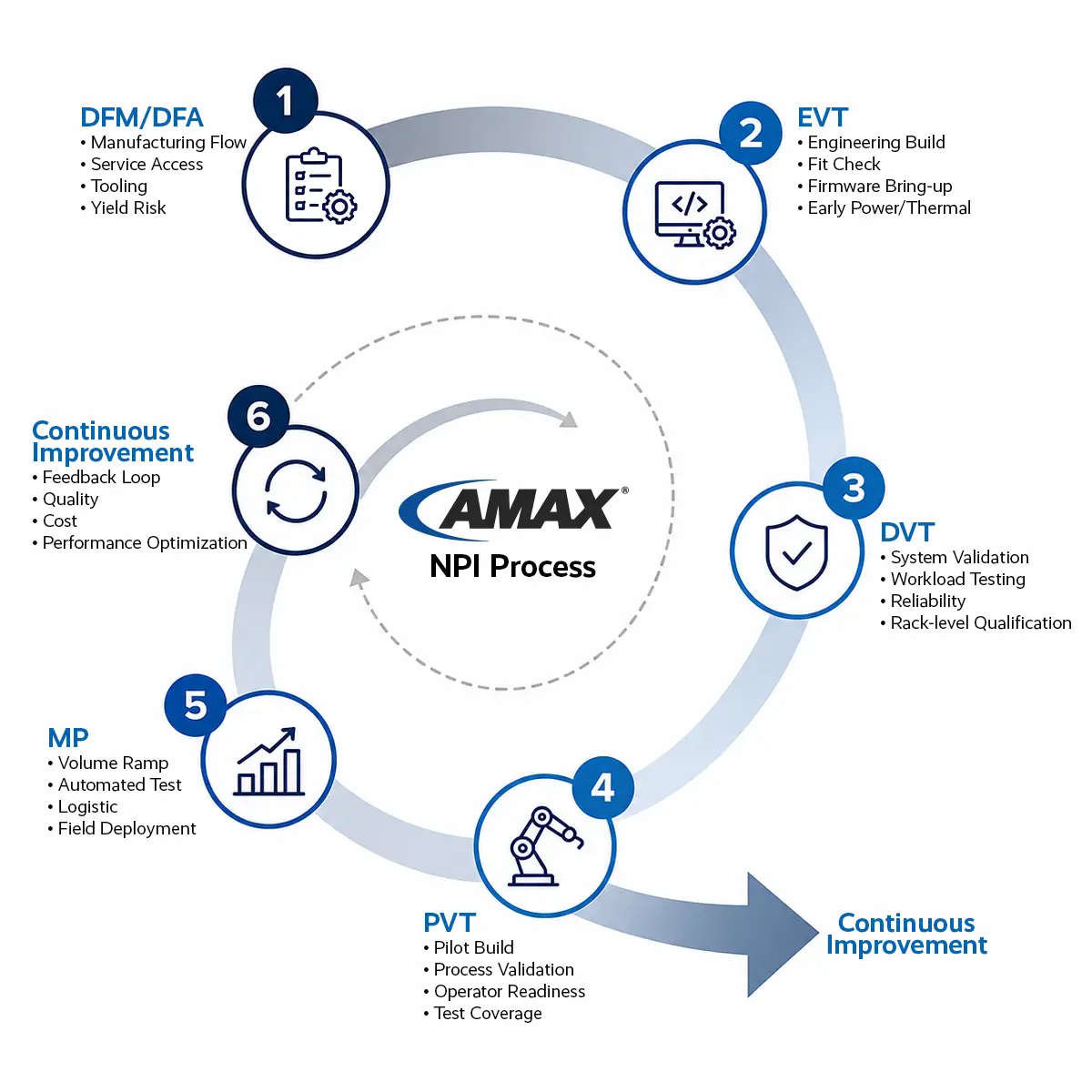
The NPI process includes engineering review, sample builds, validation planning, configuration control, issue tracking, and readiness checkpoints. This gives ISVs a controlled path to move from prototype to pilot build and then to repeatable production.
AMAX NPI Stage-Gate Process
DFM/DFA
Prototype Builds and Engineering Samples
AMAX produces engineering samples for early system evaluation, software development, performance testing, customer demonstrations, and design review. Build results provide practical feedback on component compatibility, assembly requirements, thermal behavior, power consumption, service access, and system operation.
EVT, DVT, and PVT Support
Structured validation phases provide increasing levels of product and process maturity.
Engineering Validation Test
Confirms that the initial system architecture and engineering design meet core functional requirements.
Design Validation Test
Verifies the refined design against performance, thermal, power, mechanical, firmware, and software requirements.
Production Validation Test
Confirms that manufacturing processes, documentation, tooling, test procedures, and quality controls can support repeatable production.
Hardware and Software Validation
AMAX evaluates the complete system across hardware, firmware, operating system, drivers, management tools, and customer software.
Design for Manufacturing and Test
Prototype builds reveal assembly complexity, cable-routing issues, component-access limitations, test coverage gaps, and other production concerns. Engineering teams use these findings to improve assembly consistency, inspection access, service procedures, and production test efficiency.
Configuration and BOM Control
AMAX maintains controlled system configurations throughout NPI, including bill-of-material revisions, approved component selections, firmware levels, software versions, and build instructions. Documented change control ensures that each prototype and pilot unit can be traced to its approved configuration.
Issue Tracking and Corrective Action
Design, component, assembly, and test issues are recorded, assigned, reviewed, and resolved through a controlled process. Corrective actions are verified before closure, creating a documented record of product maturity and reducing the likelihood of recurring issues during production.
Pilot Builds and Production Release
Pilot builds verify the product using intended manufacturing processes, documentation, quality controls, and test requirements. Build data and yield results are reviewed against release criteria before the configuration is approved for volume production.